
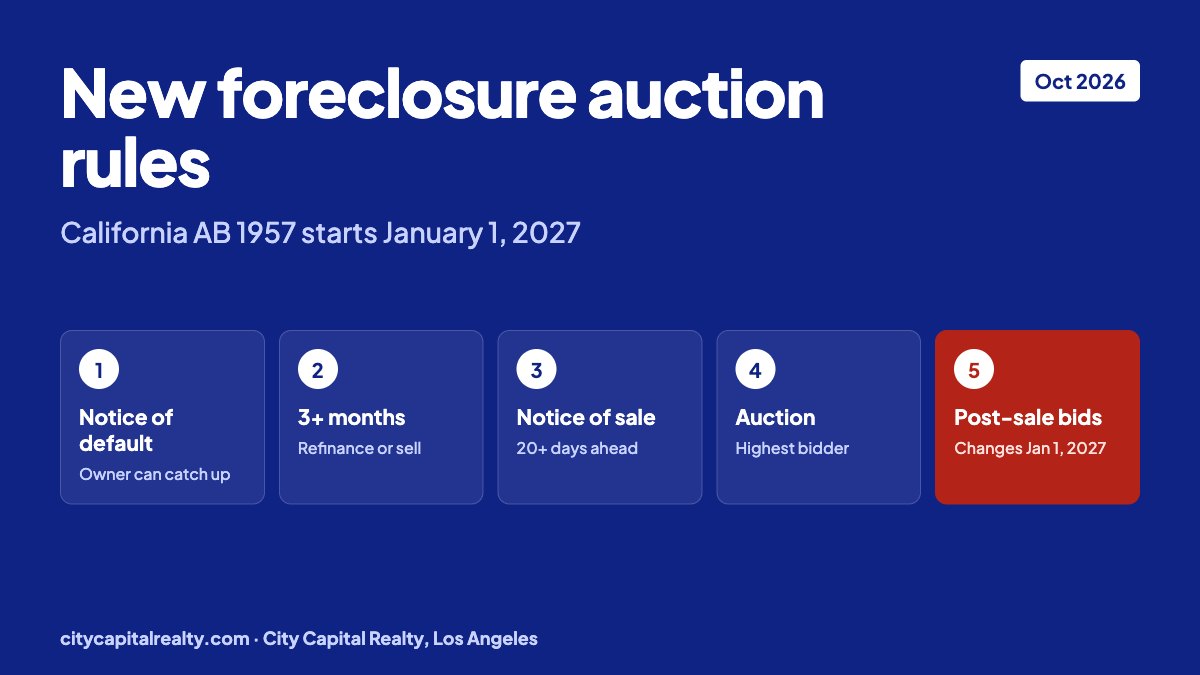
A California foreclosure moves through five steps. AB 1957 rewrites the last one, starting January 1, 2027.
- 1Notice of defaultDay 0
- 23+ monthsCatch up or refinance
- 3Notice of sale20+ days ahead
- 4AuctionSale day
- 5Post-sale bidsChanges Jan 1
Starting January 1, 2027, California changes who can buy a home after a foreclosure auction. The new law, AB 1957, arrives as foreclosure filings climb for a second year and bank mortgage rates sit above 7%. Here is what changes, what stays the same, what it looks like in real life, and what Los Angeles homeowners, investors and borrowers should do now.
| What | Now | Compared with | Change |
|---|---|---|---|
| AB 1957 takes effectSigned September 18, 2026 [1] | Jan 1, 2027 | Today | 76 days |
| U.S. bank repossessionsATTOM, August 2026 [13] | 5,794 | August 2025 | +42% |
| California foreclosure filingsATTOM, first half of 2026 [12] | 21,543 | First half of 2025 | +12.8% |
| 30-year fixed mortgageFreddie Mac, October 15 [18] | 7.40% | 6.27% a year ago | +1.13 pts |
| Fed funds target rangeNext meeting October 27–28 [15] | 3.75–4.00% | Raised September 16 | +0.25 pt |
The short version
- What changes: after January 1, 2027, prospective owner-occupants can no longer use California's post-auction bidding window. Tenants and certified nonprofits still can, under tighter rules. [2]
- What stays: everything before the auction. Owners still get at least three months after a notice of default, and can still catch up or pay off the loan before the sale. [6]
- Why now: California foreclosure filings rose 12.8% in the first half of 2026, and U.S. bank repossessions were up 42% in August from a year earlier. [12] [13]
- Where it bites in LA: on homes above the $1,249,125 FHA limit, like most of Beverly Hills, Santa Monica and Sherman Oaks, the auction result will usually be final. [9]
- What to do: owners behind on payments should act before the sale date; auction buyers should check value and lien type first.
Three dates to watch
- Oct 27–28Federal Reserve meeting. Markets give about a 15% chance of another hike. [16]
- Nov 3California election day, including local Los Angeles measures that affect property sales.
- Jan 1, 2027AB 1957 takes effect: the new post-auction bidding rules apply.
What AB 1957 changes
Since 2021, California has let certain buyers make a bid after a foreclosure auction on 1–4 unit homes, even if an investor already won the auction. This came from SB 1079, a law meant to keep more homes with the people who live in them. [5] [8]
AB 1957 rewrites parts of that process. It passed both houses without a single no vote, 39–0 in the Senate and 62–0 in the Assembly, and the governor signed it on September 18, 2026. [1] [3] It was backed by the trustees who run California foreclosure sales and by private mortgage lenders. [3] [4]
Who can still bid after the auction
Prospective owner-occupant
Someone who promises to live in the home.
Removed Jan 1, 2027Tenant of the home
Renters already living there.
Only if value ≤ $1,249,125Nonprofit or land trust
Groups that keep homes affordable.
Needs state (HCD) certificationAuction winner
Usually an investor who bid at the sale.
Win stands more oftenSources: Fortra Law's summary of the signed bill [2]; California Mortgage Association [4].
Post-sale bidding today
- Tenants of the home can bid
- Prospective owner-occupants can bid
- Nonprofits, community land trusts and some public entities can bid
- Rules reach more types of sales
After January 1, 2027
- Prospective owner-occupants removed
- Tenants can bid only if the home's value is at or below the FHA loan limit, it has a valid certificate of occupancy, the lease began before the notice of default, and they stay at least one year
- Nonprofits need state housing (HCD) certification
- Only first-lien sales of 1–4 unit homes; junior-lien sales are taken out
- Improper bidders face a penalty of one-third of the home's fair market value
Law firms' summaries differ on some timing details, so check the final text of Chapter 279 with an attorney before you rely on exact days. [2]
Real cases: why the rules changed
AB 1957 did not come out of nowhere. Here are three recent Los Angeles cases that show what is at stake for owners and buyers.
Over $350,000 of equity, gone for one cent
A Pacoima home estimated at about $900,000 sold at a trustee's sale on November 4, 2025 for $540,754.49, one penny over the debt. The owner says she had sent a complete loan-help application days before the sale. A wrongful-foreclosure suit followed, and a proposed settlement would undo the sale. [21]
Source: a press release from the consumer groups that represented the owner; the settlement was still "proposed." We do not name the owner.
A fake "owner-occupant" outbids the real winners
After an auction in Marina del Rey, the top bidders were outbid in the post-sale window by a man who swore he would live in the home. The bidders said he was a straw buyer for someone else. A jury found both men liable and awarded $267,000 in lost profits, in what the winning firm calls the first jury trial under the post-sale bidding law. [22]
Source: the plaintiffs' own law firm. This is exactly the type of bidder AB 1957 removes.
Fire survivors fall behind
From January to September 2025, at least 121 homes in the Eaton burn scar and 91 in the Palisades burn scar went into mortgage foreclosure, the most in three years, and 44% of homes sold there went to corporate buyers. [24] In September 2026 the state doubled fire survivors' mortgage forbearance to 24 months. [25]
Source: ABC7 Los Angeles data report; Governor's office.
The Senate's own analysis of the bill quotes its author: post-sale buyers were getting homes for "as little as one cent more than the winning bid." [23] The lesson for owners is the same in every case: the safest time to protect your equity is before the auction, not after it.
California foreclosure timeline, step by step
AB 1957 only changes the last step. Everything before the auction stays the same, and that is where owners have the most options.
Notice of default
The lender records a notice of default. The owner can catch up on missed payments during this time.
Day 0At least 3 months
California law requires at least three months before the next step. This is the best time to refinance or sell.
[6]Notice of trustee's sale
The sale date is set and published at least 20 days ahead.
[7]Auction
The property is sold to the highest bidder at the trustee's sale.
Sale dayPost-sale bidding window
For 1–4 unit homes, certain buyers can still bid after the auction: 15 days to bid or give notice, up to 45 days in total. AB 1957 narrows who those buyers are.
[8]
What has not changed: your rights before the sale
- Catch up (reinstate). You can pay the missed amount, plus fees and costs, until five business days before the sale date, and the loan goes back to normal. [26]
- Pay off the loan (redeem). Paying off the whole loan, for example with a sale or a new loan, stops the foreclosure up to the sale. [27]
- Time. At least three months between the notice of default and the notice of sale, then at least 20 more days before the auction. [6] [7]
- If it is your own home (a first loan on an owner-occupied 1–4 unit home): the servicer must contact you at least 30 days before recording a default, cannot move ahead with a sale while a complete loan-modification application is pending, and cannot foreclose while you follow an approved plan. [28]
- Fire survivors. New laws signed September 17, 2026 (AB 1842 and AB 1847) extend mortgage forbearance for Eaton and Palisades fire survivors to 24 months and require servicers to offer to move paused payments to the end of the loan. [25]
What this looks like in real life
An example to show how the rules play out. The owner and numbers are made up; the steps, timelines and loan terms are real.
An owner in Sherman Oaks has a home worth about $1,400,000, close to the area's typical price. [11] They owe $520,000. After a job loss they fall six payments behind, and the lender records a notice of default. With late fees and costs, $560,000 is needed to clear the loan.
Path A: acts in month two
- Calls a private lender; the loan is reviewed on the home's equity
- A $560,000 bridge loan funds in about 7 business days and pays off the default (40% of value)
- Interest is $4,200 a month; the owner sells on their own timeline five months later
- Cost of the bridge loan for five months, including the fee: about $32,200
- Keeps roughly $840,000 of equity before selling costs
Path B: waits for the auction
- Three months pass, then a notice of sale sets a date
- The home goes to auction. Investors bid to buy below market
- Any money above the debt (the "surplus") goes to the owner only after a claims process
- Price, timing and moving date are no longer the owner's choice
- From 2027, because the home is above the FHA limit, there are no tenant or owner-occupant post-sale bids: the auction result stands
Example only, not a loan offer or commitment to lend. Rates and fees are subject to change without notice. Some restrictions may apply. Subject to credit approval.
Foreclosures are rising again
Foreclosure activity is still far below the 2009–2011 crisis, but it has been climbing. In August 2026, ATTOM counted 40,277 U.S. properties with a foreclosure filing, up 13% from a year earlier. Bank repossessions jumped 42%. [13] California recorded 21,543 filings in the first half of 2026, up 12.8%, and 2,565 new foreclosure starts in August alone. [12] [13] In the Los Angeles metro area, ATTOM counted 8,503 foreclosure starts in 2025. [29]
Source: ATTOM year-end foreclosure reports [29] [30] [31] [32]
Sources: ATTOM August 2026 and mid-year 2026 foreclosure reports [13] [12]
Where AB 1957 hits in Los Angeles
Under AB 1957, tenants can only use the post-sale window when the home is worth no more than the FHA loan limit, which is $1,249,125 in Los Angeles County for 2026. [9] So the same law plays out very differently across the city. [11] [10]
- Above the limit: tenants can't use the post-sale window
- Right at the line: depends on the home
- Below: tenants keep their window
For owners on the Westside and in the hills
Above the FHA line, fewer buyers can use the post-sale window, so the auction result is more likely to stand. The time before the sale matters even more. If the property has equity, that equity is what a refinance or bridge loan can protect.
The rate backdrop: bank loans cost more
The Federal Reserve raised its target range to 3.75–4.00% on September 16. [14] Its next meeting is October 27–28, and futures markets put the odds of another hike at about 15%, down from more than 50% a month ago. [15] [16] The 10-year Treasury yield, which drives mortgage rates, was 5.10% on October 15. [17]
- 30-year mortgage
- 10-year Treasury
- Fed rate
- 9% bridge loan
Sources: Freddie Mac PMMS [18]; U.S. Treasury [20]; New York Fed [19]; City Capital Realty [33]
In early 2021 a bank mortgage cost about 6 points less than a 9% bridge loan. Today the gap is under 2 points, and it shrank week after week this fall:
Source: Freddie Mac PMMS [18]. Red bars are weeks at 7% or higher. The dashed line is a 9% bridge loan rate. [33]
How to stop a foreclosure in California
The most important date is the sale date. Until then, you have four main ways to stop a foreclosure in California:
- Catch up: pay the missed amount plus fees until five business days before the sale. [26]
- Ask your lender for help: a loan modification or repayment plan. On your own home, a complete application pauses the sale. [28]
- Sell the property before the sale date and keep the equity.
- Pay off the loan with a new one: a refinance, or a short-term foreclosure bailout loan if a bank can't move fast enough. [27]
Foreclosure bailout loans: how a bridge loan stops the sale
A foreclosure bailout loan is a short-term bridge loan that pays off the past-due loan in full, so the sale is cancelled. It is based mainly on the property's equity, not on a perfect credit score, which is why it can close in days instead of months. Then you sell or refinance on your own schedule. Try your own numbers:
Try it: could a bridge loan stop the sale?
Move the sliders to your numbers. It updates instantly and nothing you enter leaves this page.
- Bridge loan
- $560,000
- Monthly interest (9%)
- $4,200
- Minimum cost*
- $28,000
- Equity you keep
- $840,000
This fits our terms: the loan is 40% of the home's value.
*Minimum cost = 4 guaranteed monthly payments plus the 2% origination fee. "Total needed" is the past-due loan payoff plus fees and costs. Example only, not a loan offer or commitment to lend. Escrow and title costs not included. Rates and fees are subject to change without notice. Some restrictions may apply. Subject to credit approval.
We review loans based mainly on the property and its equity, and we can fund in as little as 7 business days. [33]
If you buy at foreclosure auctions
- Check the FHA limit first. On homes worth more than $1,249,125, tenant post-sale bids should not apply after January 1, so your auction win is more likely to stand. [9]
- Check the lien. AB 1957 limits the post-sale process to first-lien sales. [2]
- Plan your money for the waiting period. On homes that still qualify for post-sale bids, the sale is not final right away. Have funding that can wait without costly extensions.
- Line up rehab or hold financing early. A bridge loan closed against the property after the deed records lets you get your cash back out quickly.
Facing a sale date, or buying at auction?
Talk to Shawn Rabban directly. We look at the property and its equity, give clear terms, and can fund in as little as 7 business days.
Frequently asked questions
When does AB 1957 take effect?
January 1, 2027. The governor signed it on September 18, 2026, as Chapter 279 of the Statutes of 2026.
How do I stop a foreclosure in California?
Before the sale you can catch up on missed payments (until five business days before the sale), ask your lender for a modification, sell the property, or pay off the loan with a refinance or a foreclosure bailout loan. After the sale it is usually too late.
Does AB 1957 stop foreclosures?
No. It changes who can buy a home after a foreclosure auction. Owners in default keep the same rights and time before the sale to catch up, refinance or sell.
Who can no longer bid after the auction?
Prospective owner-occupants are removed from the post-sale bidding process. Tenants can still bid on qualifying homes worth no more than the FHA limit, and nonprofits need state housing (HCD) certification.
Which LA homes are above the FHA limit?
The 2026 FHA limit for Los Angeles County is $1,249,125. Typical homes in Beverly Hills, Santa Monica and Sherman Oaks are above it; typical homes in the City of Los Angeles are below it.
What is a foreclosure bailout loan, and can it stop a sale?
A foreclosure bailout loan is a short-term bridge loan that pays off the past-due loan before the trustee's sale. It can stop the sale if the property has enough equity and the loan closes before the sale date. We lend up to 70% of value and can fund in as little as 7 business days.
Is this legal advice?
No. This article explains the law in plain language. Talk to a California real estate attorney about your own situation.
Sources
- CalMatters Digital Democracy, AB 1957 (2025–2026), status and votes (opens in a new tab)
- Fortra Law, “AB 1957: California foreclosure changes” (September 23, 2026) (opens in a new tab)
- United Trustees Association, “AB 1957 passes California Assembly and heads to Governor” (August 25, 2026) (opens in a new tab)
- California Mortgage Association, bill signing update (October 5, 2026) (opens in a new tab)
- California Legislature, SB 1079 (2020), the law that created the post-sale bidding process (opens in a new tab)
- California Civil Code § 2924 (notice of default and the three-month wait) (opens in a new tab)
- California Civil Code § 2924f (notice of sale) (opens in a new tab)
- California Civil Code § 2924m (post-sale bids by eligible buyers) (opens in a new tab)
- FHFA 2026 loan limits (FHA ceiling for high-cost areas), via Calculated Risk (opens in a new tab)
- California Association of Realtors, county sales and price activity (August 2026) (opens in a new tab)
- Redfin housing market pages for each city (three months ending September 2026) (opens in a new tab)
- ATTOM, 2026 Mid-Year U.S. Foreclosure Market Report (July 16, 2026) (opens in a new tab)
- ATTOM, August 2026 U.S. Foreclosure Market Report (September 17, 2026) (opens in a new tab)
- Federal Reserve, FOMC statement, September 16, 2026 (opens in a new tab)
- Federal Reserve, FOMC meeting calendar (opens in a new tab)
- GuruFocus, citing CME FedWatch rate-hike odds (mid-October 2026) (opens in a new tab)
- Federal Reserve, H.15 Selected Interest Rates (10-year Treasury) (opens in a new tab)
- Freddie Mac, Primary Mortgage Market Survey (weekly 30-year fixed rate) (opens in a new tab)
- Federal Reserve Bank of New York, Fed funds target range history (opens in a new tab)
- U.S. Department of the Treasury, daily par yield curve (monthly averages) (opens in a new tab)
- National Law Review (press release from the Nonprofit Alliance of Consumer Advocates and Consumer Defense Law Group), “Rare trustee sale reversal returns over $350K equity to Los Angeles homeowner” (March 24, 2026) (opens in a new tab)
- The Ryan Firm, “The Ryan Firm wins first § 2924m jury trial” (the plaintiffs' law firm) (opens in a new tab)
- California Senate Judiciary Committee, analysis of AB 1957 (hearing June 30, 2026) (opens in a new tab)
- ABC7 Los Angeles, foreclosures and corporate buyers in the Palisades and Eaton burn scars (January 2, 2026) (opens in a new tab)
- Office of Governor Newsom, AB 1842 and AB 1847 signed for Eaton and Palisades fire survivors (September 17, 2026) (opens in a new tab)
- California Civil Code § 2924c (right to reinstate until five business days before the sale) (opens in a new tab)
- California Civil Code § 2903 (right to redeem by paying off the loan) (opens in a new tab)
- California Civil Code §§ 2923.5, 2923.6 and 2924.11 (Homeowner Bill of Rights: contact before default, no dual tracking, no sale while on an approved plan) (opens in a new tab)
- ATTOM, 2025 Year-End U.S. Foreclosure Market Report (January 15, 2026) (opens in a new tab)
- ATTOM, 2020 Year-End U.S. Foreclosure Market Report (January 14, 2021) (opens in a new tab)
- ATTOM, 2016 Year-End U.S. Foreclosure Market Report (January 12, 2017) (opens in a new tab)
- Mortgage News Daily, RealtyTrac (now ATTOM) 2010 year-end foreclosure report (January 13, 2011) (opens in a new tab)
- City Capital Realty, Bridge loan terms
This article is for general information only and is not legal, financial or investment advice. Laws and market data change; figures are as of the dates shown. Talk to a California real estate attorney about your own situation. City Capital Realty is licensed in California (DRE 00667328, NMLS 298861 / 729817). Loans are for business-purpose real estate and subject to credit approval.